Furnishing a villa by the sea is not decorating: it is choosing materials that will still look good in ten years, after ten summers of sun, salt and humidity. Contemporary Mediterranean interior design is not a magazine style but a response to that climate: houses that are cool in July, bright in January and do not demand constant upkeep. This guide sets out what works on Alcúdia Bay and what, from experience, does not.
Four principles before buying a single piece
- Inside and outside are the same house. In Mallorca you live half the year with the doors open. When floor, colour and furniture continue from the living room onto the terrace, the house feels larger and more coherent.
- Light rules. With 300 days of sun, the problem is not having light but taming it. Shade, filters and matt surfaces are worth more than any lamp.
- Everything the sea air touches must be designed for it. Metals, woods, fabrics: salt does not forgive. We detail it in anti-salt materials.
- Fewer pieces, better ones. Mediterranean space breathes. A house full of furniture is a house that feels hot in August.
Materials that age well by the sea
- Floors: local natural stone (Santanyí, treated marés), large-format technical porcelain or microcement. All three withstand sand, humidity and temperature swings, and stay cool underfoot in summer.
- Woods: oak or ash indoors; iroko or teak for anything facing outside. Avoid thin veneers and chipboard in humid areas: they swell.
- Metals: A4 stainless steel or marine-grade lacquered aluminium for anything within 500 metres of the sea. Untreated iron and brass rust in two winters.
- Textiles: linen and cotton indoors; UV-treated outdoor fabrics (solution-dyed acrylics) for cushions and awnings. Linen creases; Mediterranean linen creases well.
- Natural fibres: rattan, wicker, rope and esparto, as traditional here as they are durable, for seating, lamps and outdoor rugs.
The palette: what Mallorca's light asks for
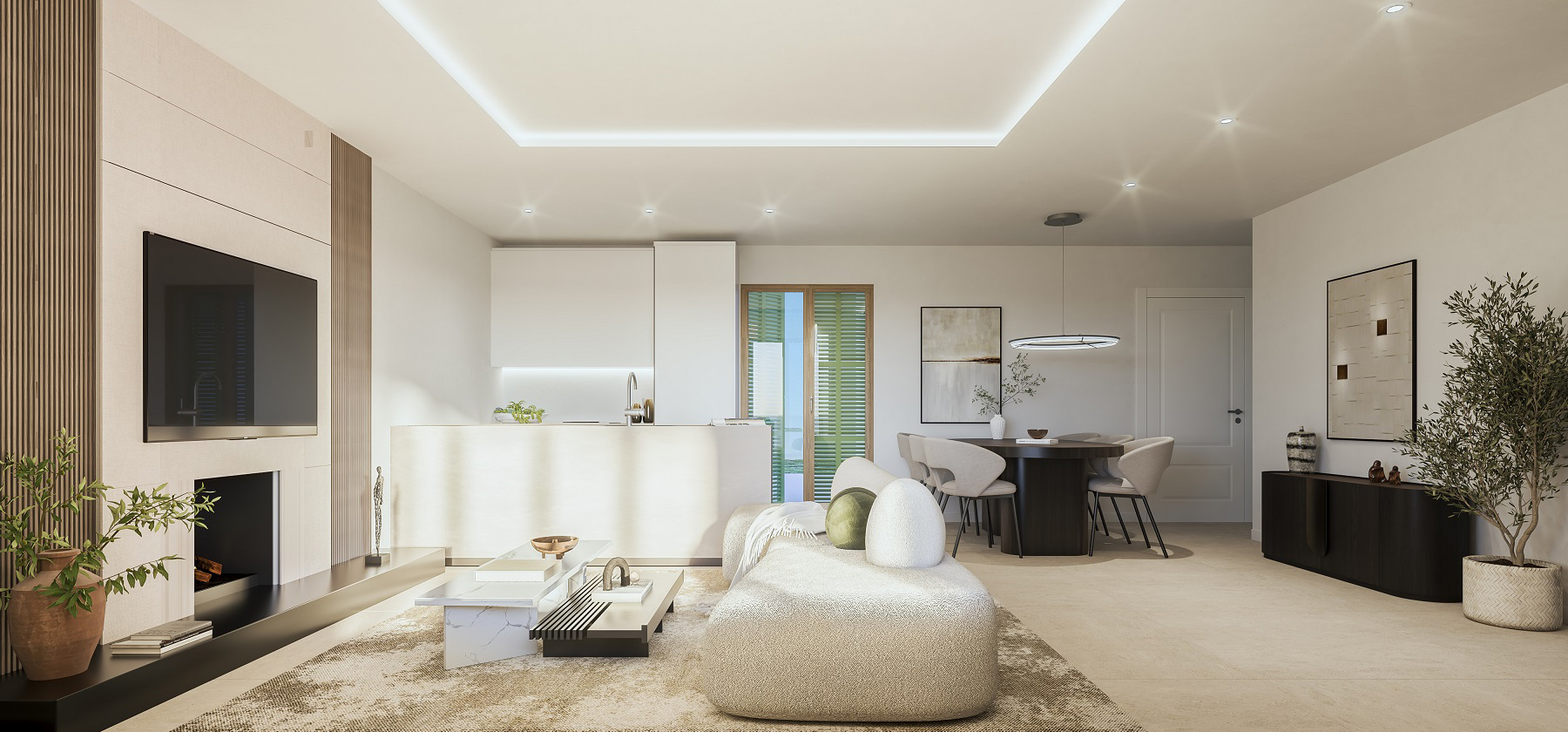
- Base: off-whites, sand, stone and greige. They reflect light without glare and do not heat up.
- Accents: the blue of the bay, the olive green of the Tramuntana, the terracotta of the earth. One or two, not all three at once.
- What to avoid: glossy surfaces and saturated colours over large areas. Under the sun here, a glossy wall dazzles and a dark sofa burns.
Shade and ventilation: the furniture you don't see
- Mallorcan shutters or adjustable louvres: they filter the sun and let the air through. The most Mediterranean element in the house, and the most effective.
- Pergolas and awnings: a terrace without shade goes unused between noon and five from June to September. A folding-arm awning or a bioclimatic pergola depending on orientation.
- Cross-ventilation: furniture must not block the path of air between façades. The afternoon embat cools the whole house if it is allowed through.
- Ceiling fans: silent, with large blades and a DC motor. They cut air-conditioning use, and residents prefer them.
Lighting: warm, layered, and outdoors too
- Colour temperature: 2,700 K in the living room and bedrooms, 3,000 K in the kitchen and bathrooms. Cold light breaks the Mediterranean atmosphere.
- Layers: dimmable general, task lighting for reading and cooking, and low ambient light. Never a single central ceiling fitting.
- Outdoors: the terrace is one more room from May to October. Low lights around the perimeter, none pointing at the eyes, and respect for the night sky, which in Alcanada can still be seen.
Local craft, well used
Mallorca has a living craft tradition that sits naturally in a contemporary house: Gordiola blown glass, Pòrtol ceramics, llengües fabrics and palm-leaf basketry. One or two pieces with a story give a new house a soul; a whole house of folklore does not.
Mistakes we see often
- Furniture from the city house. The dark velvet sofa and the solid walnut table are heavy, feel hot and suffer in humidity. The Mallorca house needs a different wardrobe.
- Thick rugs and fitted carpets. They hold humidity and sand. Flat-weave fibre rugs or nothing.
- Indoor furniture outdoors. Anything that sleeps on the terrace must be genuinely outdoor-rated. Everything else lasts a summer.
- Forgetting logistics. You are on an island: 8-to-16-week production lead times come on top of sea freight. Furnishing a whole villa takes three to six months from the first order. It starts with the build, not after it.
The budget: what it depends on
What it costs to furnish a villa depends above all on the level of the pieces, on how many are made to measure rather than bought from a catalogue, on the textiles, the outdoors and the lighting. That is why it pays to set aside a budget line of its own from the start, rather than leaving it for the end, and to ask the interior designer for a quote once the project is defined. What is constant: the outdoors, with pergola, furniture and shade, costs more than almost everyone budgets for.
Conclusion
A well-dressed Mediterranean villa is recognisable because the effort does not show: materials you can touch, light that does not bother, shade where it is needed and air that moves. Everything else is pieces that get replaced. And in quality new-build, where the envelope is already well resolved, the interior is the only thing left to decide: it is worth deciding with the same judgement.
Interested in Alcudia Luz?
At Alcudia Luz every villa is delivered with the option to personalise finishes and interiors. Ask us about the process.